
A special snowflake
An interview with the poet Toni Stuart

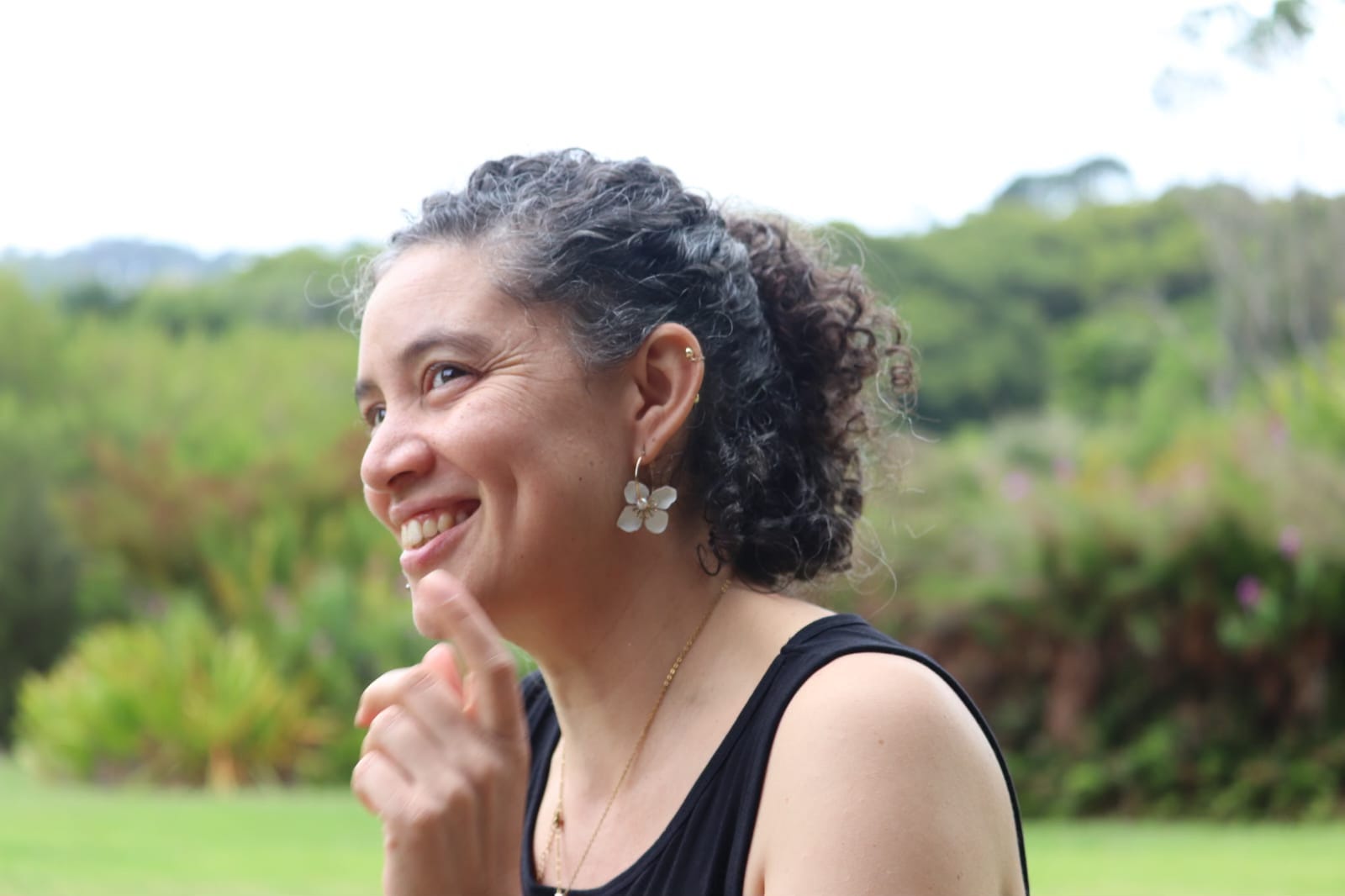
Toni Giselle Stuart was once named one of Mail & Guardian’s Top 200 Young South Africans. She is indeed a top human being, on or off lists – a writer I’ve always thought of as determined, focused, disciplined and courageous.
Years ago, I remember Toni saying she had decided to make a life as a poet. If anyone else had said it, I would have thought they hadn’t done their homework. Because it was Toni though, I knew she would do it. I just didn’t know how.
I admire people who just quietly get on with living life on their own terms – not buying into any of the pre-cooked formulas – and Toni never does the expected thing. She retreats for ages, and then emerges, fresh, questioning, seemingly frowning and laughing at the same time. This is the image I have of her: someone who figures deeply while living lightly.
I’ll be presenting a short slot during the next round of The Writer’s Oasis – 120 Days of Creating, which starts again in August, and which Toni runs regularly, so it seemed like a good time to ask her how she carved such a unique life for herself. This interview is divided into two parts. The second part will be in your inboxes tomorrow morning.
‘Because I’m built different’
Can you remember the first time you heard or read a poem and something about it hooked or held you? Tell us about it:
For those of us
who were imprinted with fear
like a faint line in the center of our foreheads
learning to be afraid with our mother’s milk
for by this weapon
this illusion of some safety to be found
the heavy-footed hoped to silence us
– from ‘A Litany for Survival’ by Audre Lorde
The first time I read it, these first four lines sat in my chest. The words ‘learning to be afraid with our mother’s milk’ struck me. Someone had put words to my childhood. As a child and teen, I often felt suffocated by mother’s fear. It wasn’t always overt, it was often subtle. As an adult, I realise now that my mother was a deeply sensitive person, and, she grew up during apartheid South Africa, where as a brown woman there was a lot for her to fear. I was also born in the 1980s, where there was a lot for her to fear. I often felt that her fears inhibited me, both directly and indirectly. But reading Lorde’s poem, something in me felt seen and was able to understand both myself and my mother differently.
The poem ends with the lines:
and when we speak we are afraid
our words will not be heard
nor welcomed
but when we are silent
we are still afraid
So it is better to speak
remembering
we were never meant to survive.
Those final three lines also woke up something in me. I am going to die like everyone else. My time here is limited, I don’t have to be so precious, so fearful of saying what I need to say, or being who I really am.
Look, it’s been a lifelong journey of unlearning the old fears and silences and growing new courage to speak and be. But, I am grateful for it, in all of its shades and turns.
What did you dream about being when you grew up? And how did that work out? How did you become who you are now…the poet you?
You know, the first thing I wanted to be was a teacher. I remember so vividly being 10 years old, and wanting to be a teacher when I grew up. It was 1993, and all the adults around me were saying: ‘There’s no future for teachers in South African anymore.’ I was too young to really understand what they meant, and young enough to just believe them, so I let it go.
Then for a long time I didn’t know what I wanted to do after school. At one point I thought I’d become a baker (I used to bake a lot and sell at school).
Then when I was in Matric, I had already been writing poetry regularly for about three years. I thought: ‘I’d like to be a poet, but how do I make money from that? What job allows me to be a writer and get paid?’ Journalism came up so that’s what I studied.
I studied at Peninsula Technikon, now the Bellville Campus of Cape Peninsula University of Technology. Part of the three-year course, was a one-year internship. I got an internship at Cape Community Newspapers, part of Independent News and Media. I was 19 when I walked into the newsroom.
It was there I met Chantel Erfort Manuel, she was a journalist and a few years older than me, and our team leader asked her to show me the ropes. She was also a poet and a deep music lover. She and her now husband, André, started an independent record label and invited me to work with them organising cultural events across Cape Town, especially the Cape Flats. And that was how I did my first public performace, at 20 years old. It was at the Obz Armchair Theatre. It was a jazz music gig, the band was: Clement Benny on drums, Jonathan Rubayne on bass, Hilton Schilder on keys, Alex van Heerden on trumpet, Mac McKenzie on guitar and Mark Fransman on sax. Mr Devious (a renowned hip hop artist from Mitchell’s Plain) and I were the breaks between music sets. We each deliver a short set: he emceed and I read poetry. I’ll never forget the feeling of being behind the mic that night. I was so nervous before my set, that I could barely speak. But once I started reading, this calm came over me, and I felt as if everything in the world made sense. I had this overwhelming feeling of: “I know who I am.”
That was October 2003. After the internship I got a job at CCN and worked there for five years. All the while writing and performing poetry in the evenings and on weekends, organising gigs with Chantel and Andre. I met Malika Ndlovu, and she invited Chantel and me to be part of the And the Word Was Woman poetry collective. We did stage performances in parliament, at festivals, and cultural events.
I kept writing poetry. I left journalism, went travelling. Came home and worked freelance. Then worked in youth development for a bit, using the creative arts. I co-founded a youth development organisation called I Am Somebody! with Nic Le Roux, which used storytelling and nature-based rites of passage to support young people to make the transition from adolescence into adulthood with intention, community support and care.
Then in 2011, I felt this strong pull to do poetry full-time. It had been there for a long time, but that year it wouldn’t leave me alone. I just had this knowing that if I didn’t listen to it, I would get ill, or things would start to go awry in my life.
So in May 2012, I started working as a full-time poet, writer & performer. In the early years I did a fair bit of project management, arts administration and curating work to make money and gain experience.
Then in 2014, I got a Chevening Scholarship to do an MA in Creative Writing & Education at Goldsmiths, University of London. That was when I chose to stop all the project management and curation work and focus solely on being an artist.
At each stage, I kept following what felt right and true for me to do. When I heard about the MA programme, I just knew I had to do it. And it changed my life, because it allowed me to study both creative writing and creative writing education. I developed my own pedagogy that year, which I now live daily in my teaching work in The Firefly Garden.
I also wrote _Krotoa-Eva’s Suite – a cape jazz poem in three movements – which re-imagines the story of the Khoe woman Krotoa, who was sent to live and work in Van Riebeeck’s house from the age of 11. I have yet to publish it, but an excerpt was turned into an audio-visual work for an exhibition. It now lives online and has been studied in university courses.
Writing that work rooted me firmly in re-telling and re-imagining ancestral histories, particularly contested colonial and slave histories.
Does your life, the way it is now, suit you? You worked hard to get it like it is. Why was it necessary for you to construct such an unusual, non-mainstream life? What did you have to sacrifice for it?:
I’m chuckling as I write this. My friend Kagiso Msimango, once said to me: ‘You’re a very special snowflake,’ and her daughter Naima, once said, about herself, ‘Because I’m built different.’ And I love both of these, because I am built different. In the past few years, I’ve come to accept that I am built different to the world around me, and most people in it. Not better or worse, just different.
I have a highly sensitive nervous system, which means that I take in, process, sort and organise sensory & other input at six times the rate of 80% of the population. That means I feel things deeply, I see things deeply, I hear things deeply, I know things deeply and I live things deeply. Because of this, my nervous system and body reaches a state of over-arousal or over-stimulation a lot quicker than most people.
For years, I didn’t know this, and I fought against my body, trying to make it keep up. I burnt out so many times.
I live and work at a pace that suits me.
Now I live and work at a pace that suits me. I’ve been able to create a rhythm where I spend mornings writing/creating, and afternoons on commissioned work, or admin and teaching in my courses. I have time to exercise, see friends, do things I love. I have a lot more space in my days.
I only say yes to work that I believe in and align with. Even when money may be tight, I no longer do work just for the money if it’s going to cost me creative time, my health or it’s going to cost more energy than what it’s worth. The money is never worth it.
What did I have to sacrifice? The egoic desire to be where everyone else is in terms of lifestyle & financial stability for my age. That is: I don’t yet own a home, or my own car. I don’t have a family yet.
For a long time, those things bothered me, but they don’t anymore. I know who I am now, in a way that I didn’t before. I feel ready for them now, and, more importantly I know that it’s possible for me to continue being the artist I am, working the way I have chosen AND have those things too.
I am always struck by the many ways you and I agree on disagreeing with things that others simply accept, want, even welcome into their lives. Have you always been a dissenter? Or did you have to grow into these quiet rebellions? Has it cost you?
I have always been a dissenter, but it hasn’t always been out loud. I felt too insecure and self-conscious as a child and teen and long into my 20s, to have the courage to be vocal about a lot of things. On reflection, I was always a dissenter in the way I lived my life, and how I chose my own path, but in terms of speaking up and saying things out loud, I wouldn’t say I was outright rebellious.
I love how you said ‘did you have to grow into these quiet rebellions?’ Yes, I did. And they do feel quiet. And more and more they are less rebellions. I am more focused on: ‘What am I growing? What am I creating? What am I building? How does all of this serve the collective? How am I being part of the creating the kinds of worlds I desire to live in, where everyone is free to be who they are?’
I want to give my energy to the things that create and grow the worlds I desire to see realised in my lifetime
We need both rebellion and building. However, I keep coming back to something, I first heard via the filmmaker Ava du Vernay. She has this incredible SXSW keynote address (2015) where she says ‘where attention goes, energy flows’. Thus, the things I give my attention to, I give my energy to. If I am rebelling against something, I am still giving my energy to that thing.
I want to give my energy to the things that create and grow the worlds I desire to see realised in my lifetime.
•This interview will continue in another Love Letter, which will be in your inbox tomorrow.
•You can find out more here about The Writer’s Oasis.
How amazing Thank you so much Karen for 'introducing' us to an inspirational person. So many resonances
Great interview! There's so much here that I want to reflect on, look forward to Part 2.