

LOVE READING CLUB’s first meeting of 2026 happened this past Saturday and it was, as always, a warm and satisfying conversation.
If you don’t know what LOVE READING CLUB is, it’s a Cape Town-based club for paid subscribers of Love Letter. We meet in person on the first Saturday of every month.
I send out an essay the previous month. The essay is available for all subscribers to read.
If you’d like to join this discussion though, let me know so I can add you to the WhatsApp group where I announce where we’ll be meeting. And remember to sign up as a paid subscriber so you can come to meeting. You can sign up for just one month or get a group subscription, if that makes it easier for you).
Click here to do that:
We meet to discuss any aspect of the essay: how it made us feel, how we agree or don’t agree with any argument, what it reminds us of, what we thought of the writing…
It’s not an academic discussion. No one’s flexing at these meeting, so don’t feel like you aren’t clever enough. You just have to love reading. That’s it.
On Saturday, 4 April 2026 at 3.30 pm, we’ll be discussing ‘Hope and Home’, an essay by Rabih Alameddine, who wrote one of my favourite novels of all time. You’ll find the essay here.
Floating into the story
Today’s Love Letter is illustrated by a photograph of a painting done by Gretchen van der Byl. I’d like to thank her for allowing me to use the picture, because it so perfectly illustrates what I am writing about.
I once did an interview with her because she is, apart from an artist whose work I hope to one day have in my home, a designer of book covers. You can read that interview here.
Something illuminating
‘The world,’ writes Emily Ogden* ‘has mundanity, duration, bullshit. Many nonsense tasks must be completed; false spirits must be tried and rejected; long periods pass in which nothing illuminating happens.’
But then you ( meaning ‘I’) find yourself in warm water, in someone’s arms, outside yourself, on an otherwise average Saturday and you experience lightening: light as the opposite of darkness and light as the opposite of heaviness.
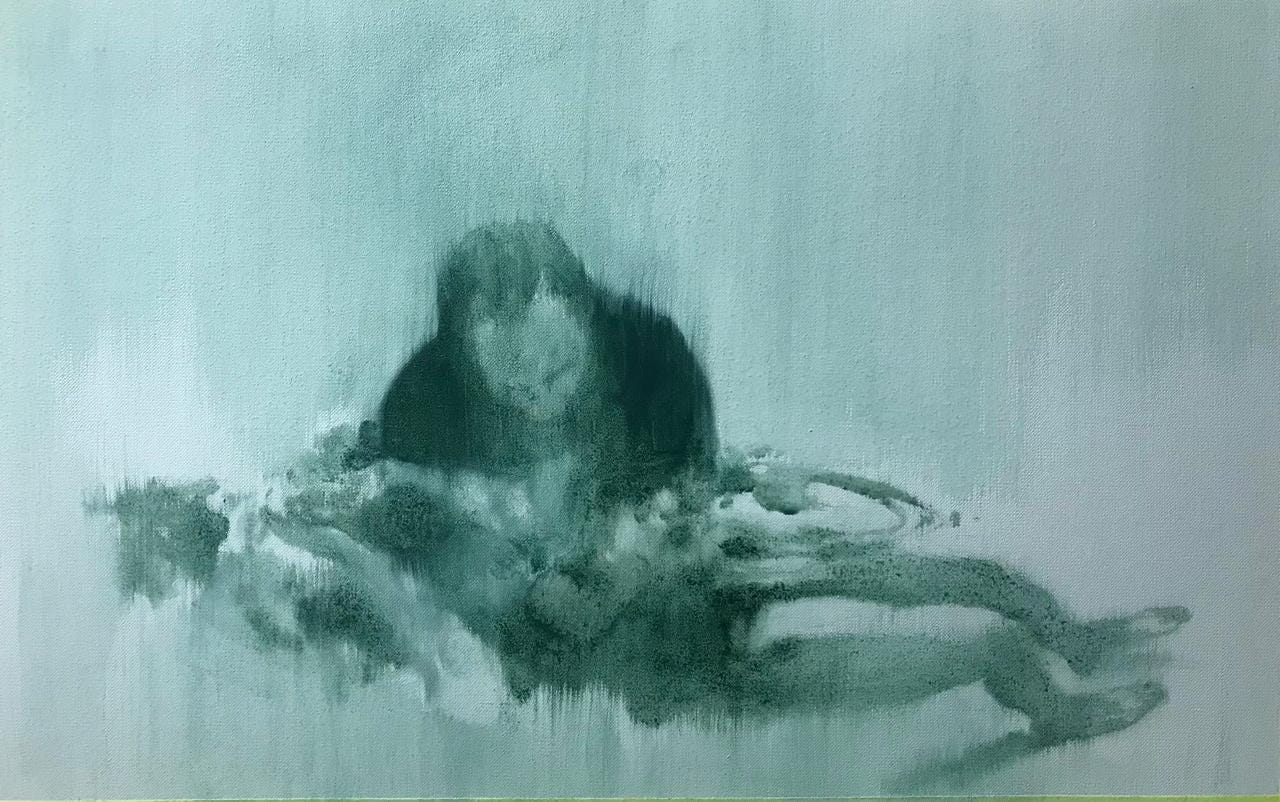
And then you wonder: does this need words? Must I write about this in order for it to have shape? To have been real? Is illumination – if it is thought of as ‘increased understanding’ – conveyable? Isn’t it better unconveyed?
I tried to read an essay once, out of curiosity, about someone’s experience of inducing astral projection. I tried to read, out of a sense that its popularity must make it readable, Eckhard Tolle’s The Power of Now. I’ve heard people trying to describe their experiences of hallucinogenic drugs.
In each case, the narrator is describing something that is real – if somewhat formless – but the experience for me, as an earnest listener or reader, is that a swirling expanse of nothingness that has inserted itself between me and the narrator. All materiality has failed, and only impenetrable abstraction remains.
Altered states
Altered states of consciousness, with their mystical overtones, are not for description, perhaps. Rooms, meals, roads, faces can be recalled and described, but not the quality of other mind states.
An altered mental state, according to one of the first attempts at defining it, is a state that can be recognised subjectively by the individual undergoing it as representing a ‘sufficient deviation in subjective experience of psychological functioning from certain general norms for that individual during alert, waking consciousness’.
You can get to an altered state in various ways, pursuing it through drugs or dance or music or meditation, or achieving it by accident or illness or a lack of sleep.
Two Saturdays ago, I bobbed out of normality in a warm indoor pool in Fish Hoek, in the arms of the free diver, wild swimmer and underwater photographer Gaby Beyers.
